


Der Euro in Südosteuropa / The Euro in Southeastern Europe
13. – 15. September 2024
Tagung Tutzing
 International, Wirtschaft
Inhalt
Die Tagung findet nicht statt.
THE EURO IN SOUTHEAST EUROPE
The euro, and previously the Deutsche Mark, has long been the currency of choice in Southeast Europe. Buying a property or a personal computer is done in euros, and previously in German marks. This reflects the region’s integration with the economies of Western Europe and, in particular, the importance of migrant workers’ remittances to the region.
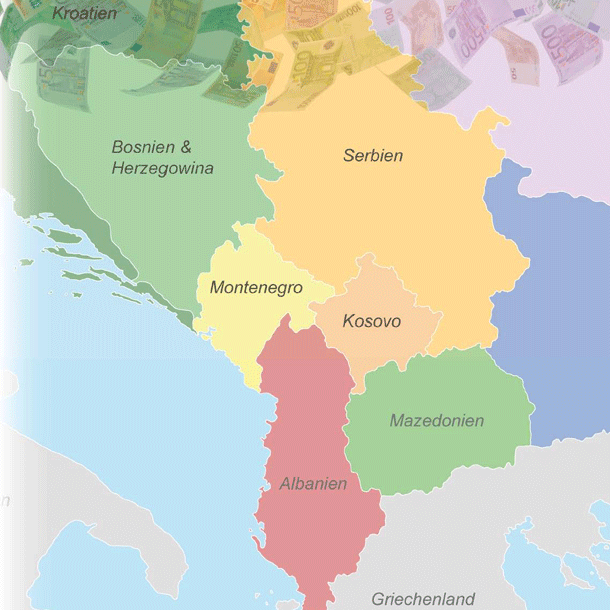
Countries in the region are increasingly adopting the euro as their official currency. With Croatia`s membership in January 2023, five countries in the region are members of the euro area (Croatia, Slovenia, Greece, Cyprus and Slovakia). Montenegro and Kosovo use the single currency but are not members of the euro area. Bosnia and Herzegovina and Bulgaria have pegged their national currencies to the euro. This patchwork of euro alignment reflects similarities with the European Union accession process in Southeast Europe.
The conference aims to take stock of recent monetary developments. We ask: How and why have some countries in the region adopted the euro? What are the economic and social consequences of their currency changeover? We also look at the other side of the coin: why are countries in the region reluctant to join or do not (yet) meet the criteria for membership, e.g. Romania and Bulgaria? Finally, the case of the Greek government in 2015 illustrates the risks associated with a possible exit from the euro area.
These examples illustrate political challenges facing the euro. Russia’s invasion of Ukraine has added a geopolitical dimension to these challenges. Overall, governments in the region are reassessing their strategic options and timetables for EU integration and euro adoption. Institutional alignment and currency risks are providing new impetus for joining or remaining outside the euro area.
The international conference invites political economy experts, participants with a focus on Southeast Europe, European Union affairs, euro area developments, and those interested in financial markets and geopolitical developments.
Jens Bastian, Southeast Europe Association
Martin Held, Protestant Academy Tutzing
Martin Held, Protestant Academy Tutzing
16.00 Uhr
Arrival of participants and registration
18.00 Uhr
Dinner
19.00 Uhr
Welcome and introduction
Dr. Martin Held
11.00 Uhr
Dr. Jens Bastian
19.15 Uhr
Keynote speech
Euro adoption and EU integration – Two sides of the same coin?
Loukas Tsoukalis
20.45 Uhr
Informal get together
Veranstaltungsleitung
Dr. Martin Held
Freier MitarbeiterReferierende
PARTICIPANTS
Gunter Deuber, Head of research, Raifeissen Bank International, Vienna
Mirko Dukovic, CIVICA fellow, European University Institute, Florence
Morina Engjellushe, European Council on Foreign Relations, Berlin
Heiner Flassbeck, Flassbeck Economics Consultancy, Saarbrücken
Yasen Georiev, Economic Policy Institute, Sofia
Alexandros Kritikos, German Institute for Economic Research, Berlin
Daniela-Maria Maris, University of Leipzig
Manuel Sarrazin, President of Southeast Europe Association, Berlin
Bernd Christoph Ströhm, Vienna Institute for International Economic Studies, Vienna
Pawel Tokarski, German Institute for International and Security Affairs, Berlin
Loukas Tsoukalis, President, Hellenic Foundation for European and Foreign Policy, Athens
PANELS
Franz-Lothar Altmann, Bucharest University
Jens Bastian, Board member Southeast Europe Association, Munich
Johanna Deimel, Board member Southeast Europe Association, Munich
Christian Hagemann, Executive Director, Southeast Europe Association, Munich
Martin Held, Protestant Academy Tutzing
Ognian Hishow, Free University Berlin
Dušan Reljic, Economic Consultant, Brussels


